Select your Language :

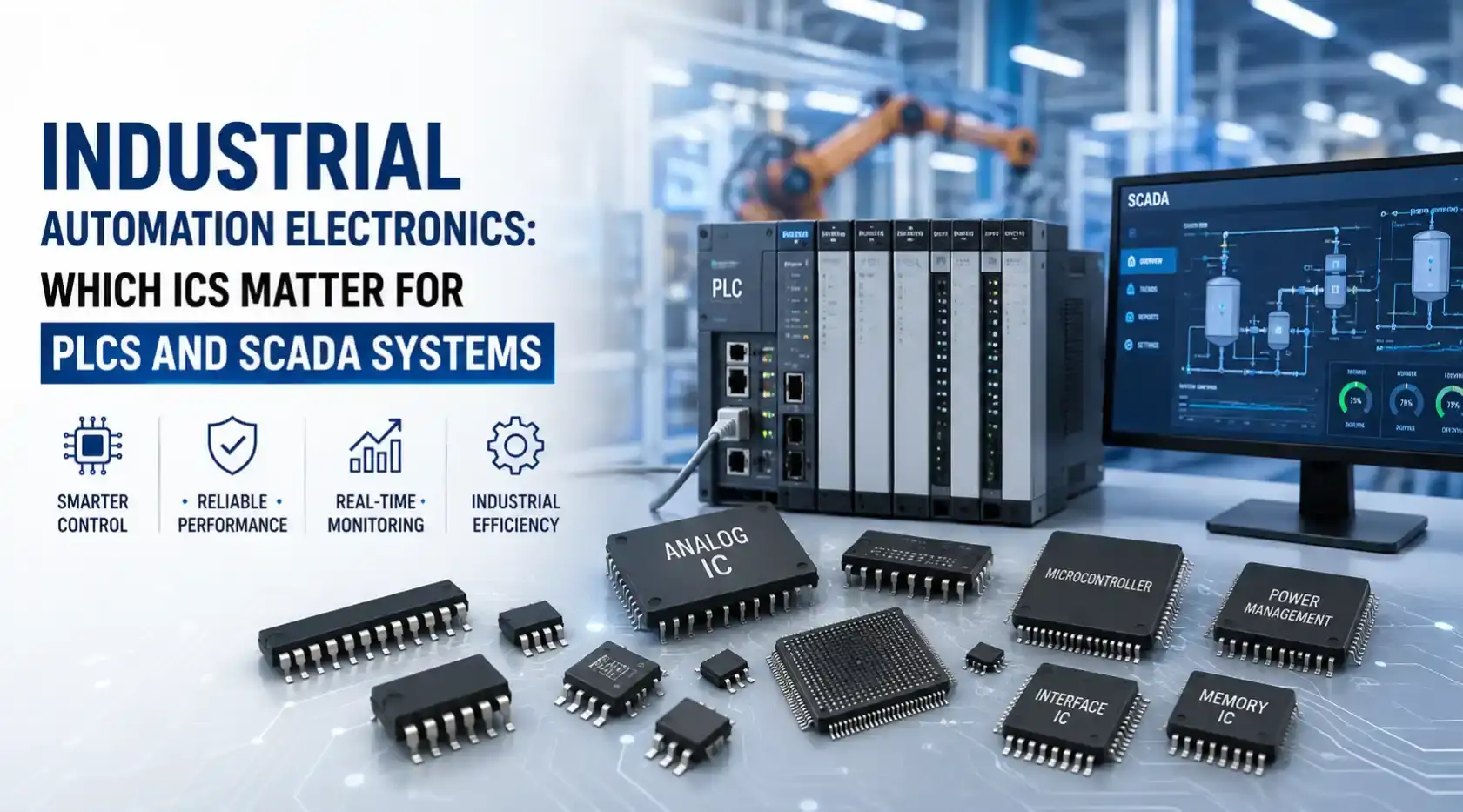
Manufacturing, oil and gas, energy, water, and transportation industries run on real-time data. Sensors collect it, PLCs process it, and SCADA systems present it to operators who make decisions based on it. Every step in that chain relies on electronic components, including ICs, and the quality and suitability of those ICs can affect system reliability. That's why PLC component sourcing is not a procurement checkbox. It's an engineering decision.
SCADA systems can incorporate MCUs, MPUs, ADCs, DACs, transceivers, DSPs, isolated gate drivers, and other ICs. The exact components vary by system architecture and application. Components used in industrial equipment may be selected for wider operating-temperature ranges, long product support expectations, and the signal and control requirements of industrial sensing and automation.
In simple terms: sensors observe what's happening – temperature, pressure, vibration, flow – and analog-to-digital converters (ADCs) convert applicable analog signals into digital data that PLCs and other controllers can process. Other ICs perform processing, communication, power management, isolation, and signal conditioning. Without suitable components at each stage, the control chain can lose accuracy or reliability.
SCADA systems collect data from sensors, controllers, and field devices, then relay it to operators at a central command point. ICs are among the electronic building blocks that make this data acquisition, processing, communication, and control possible.
Industrial automation ICs handle signal conversion, power regulation, and communication across the system. They process inputs from temperature sensors, pressure transducers, level detectors, and gas analyzers. They regulate power supplied to sensitive microcontrollers and support communication between field devices and control systems. Every function that keeps a SCADA system accurate and responsive depends on multiple hardware and software components working together.
MEMS-based sensors can feed data into PLCs, where ADCs, MCUs, and other ICs process the signals before the information reaches the HMI or supervisory system. Counterfeit or substandard ICs at any point in that chain can introduce reliability and traceability risks.
A SCADA system's hardware can include IEDs, RTUs, and PLCs that interface directly with sensors and actuators. Inside PLCs and other control equipment, you may find ADCs, RAM, EEPROM, MCUs, transceivers, and isolated gate drivers, each serving a specific function in data acquisition and control. Sourcing these components through unverified channels can increase risks related to authenticity, traceability, and component quality.
Isolated gate drivers control high-power switches such as MOSFETs, IGBTs, SiC MOSFETs, and, depending on the driver and application, GaN devices. They provide galvanic isolation between control circuitry and the power stage while delivering the gate-drive signals required to switch power semiconductors. For example, the UCC21530 is a dual-channel reinforced isolated gate driver designed for IGBTs, MOSFETs, and SiC MOSFETs, while the UCC23513 is a single-channel opto-compatible reinforced isolated gate driver for IGBTs, MOSFETs, and SiC MOSFETs.
Industrial procurement teams commonly source the following series for PLC component sourcing:
The 1ED312 family includes galvanically isolated single-channel gate drivers for IGBTs, MOSFETs, and SiC MOSFETs, with variants designed for applications including industrial automation and motor drives.
MCUs can serve as the processing core of PLCs and industrial edge devices. They can run control logic, manage sensor polling cycles, and handle communication with other systems. MCUs selected for industrial applications may offer extended temperature ranges, industrial interfaces, and long-term product support, although the exact specifications depend on the individual device and manufacturer. STMicroelectronics, for example, offers STM32 and STM8 devices with industrial temperature options and applications that include industrial control and automation.
The STM32 and STM8 families from STMicroelectronics are widely used across industrial sensing and control applications:
Sensors produce analog signals. PLCs work with digital data. ADCs are what bridge that gap, and in industrial applications, the accuracy of that conversion can affect the quality of downstream measurements and decisions.
High-resolution ADCs with low noise performance are used in industrial sensing, particularly in applications measuring changes in pressure, temperature, voltage, current, or other physical variables. The AD7606 series is a suitable example for multi-channel simultaneous sampling in industrial data-acquisition applications. The AD7606 provides 16-bit conversion with eight simultaneously sampled channels, while the AD7606 family also includes six- and four-channel variants.
SCADA systems rarely keep all their components in one room. Field devices can be hundreds of meters from the control point, and the cabling can pass through electrically noisy environments involving motor drives, high-current switching, and variable-frequency drives. RS-485 and CAN transceivers provide the physical-layer interface needed for reliable communication in these types of networks.
RS-485 can support cable runs of up to 1,200 meters under specified conditions and at appropriate data rates, with the actual achievable distance depending on factors such as cable characteristics, baud rate, topology, and installation conditions. CAN provides arbitration and error-detection mechanisms that make it suitable for real-time control and other robust embedded networks.
Commonly sourced transceiver series include:
The MCP2551 is also a CAN transceiver, but Microchip currently lists the MCP2551 as End of Life, so procurement teams should not treat it as a current-production component without checking its exact lifecycle status and available replacement.
Industrial power management ICs carry a different set of requirements than many general-purpose commercial electronics. Depending on the application, they may need to regulate voltage and current while tolerating temperature variation, electrical transients, electromagnetic interference, and other environmental stresses.
A power-management device must be selected according to its specified input-voltage range, output requirements, temperature rating, protection features, efficiency, and application conditions. For example, the LM5175 is a synchronous four-switch buck-boost controller with a 3.5 V to 42 V operating input range and protection features including current limiting, UVLO, overvoltage protection, and thermal shutdown.
Common power-management devices used in industrial designs include:
The temperature rating is one visible difference, but not the only one. Industrial-grade components may be specified for more demanding operating environments and may have wider temperature ranges or additional environmental and reliability requirements depending on the device. The exact qualification and specifications vary by manufacturer and product family.
For example, some industrial ICs are specified for operating ranges such as -40°C to +85°C, while other devices extend to +105°C or +125°C. The exact temperature range must always be checked against the manufacturer's datasheet for the specific part number and package. The AD7606, for example, is specified from -40°C to +85°C, while the UCC21530 and UCC23513 are specified from -40°C to +125°C.
Commercial-grade components may have narrower temperature specifications, but there is no single temperature range that universally defines every commercial or industrial IC.
Industrial components may also be qualified for demanding environmental conditions such as temperature cycling, humidity, vibration, EMC, and electrical transients, depending on their intended application and the manufacturer's qualification requirements.
Industrial IC lead times can be longer and more variable than buyers expect, particularly for specialized components, constrained products, or parts with limited distributor inventory. Supply can also be affected by semiconductor fabrication and packaging capacity, allocation, demand changes, supply-chain disruptions, geopolitical conditions, and product lifecycle transitions.
For this reason, procurement teams sourcing SCADA electronics should monitor manufacturer availability, distributor inventory, lifecycle notifications, and approved alternatives rather than relying solely on spot purchasing.
Industrial PLCs can remain in service for 15 to 20 years or longer, particularly where replacement involves significant downtime, engineering work, or operational risk. Maintaining a system over this duration requires active lifecycle management across three stages.
Install the PLC according to the environmental requirements specified by the manufacturer and the site's operating conditions. Document software configurations, firmware versions, hardware schematics, and component-level BOM information. Set up tracking for PCNs, product discontinuation notices, and EOL notifications from component vendors.
Monitor components with finite or condition-dependent service lives, including batteries, cooling fans, and electrolytic capacitors where applicable. Stock critical ICs while they are still available when the cost and risk justify strategic inventory. Apply appropriate software and firmware updates while maintaining configuration control and compatibility with the installed hardware.
When critical components approach discontinuation, evaluate last-time-buy requirements, approved alternatives, redesign options, and migration plans. Specialist distributors may help procurement teams locate legacy or discontinued components, but buyers should verify authenticity, exact part numbers, storage conditions, and traceability before using such stock in production or maintenance.
A SCADA system depends on many interacting hardware and software components, and ICs are important building blocks within that architecture. Sensors can be accurately calibrated and software can be well-written, but problems with an ADC, gate driver, transceiver, power-management device, or other electronic component can affect the accuracy and reliability of the control system.
Industrial automation ICs sourced through reliable channels with appropriate traceability can reduce component-related procurement risks. For procurement teams managing long-lifecycle PLCs across demanding environments, monitoring component authenticity, specifications, availability, and lifecycle status is an important part of preventing unplanned downtime.
What Is the Difference Between Industrial-Grade and Commercial-Grade ICs for SCADA Systems?
Industrial-grade ICs may be specified for wider operating-temperature ranges and more demanding environmental conditions than some commercial-grade devices. However, there is no universal temperature range that applies to every industrial or commercial IC. Buyers should check the manufacturer's datasheet for the exact operating temperature, electrical specifications, environmental qualifications, and applicable product grade.
How Do I Manage Component Availability for a PLC Designed for 20-Year Operation?
Track PCNs, product discontinuation notices, and EOL information for every critical component in your BOM from the beginning of the product lifecycle. Stock critical ICs when appropriate, qualify alternatives where possible, and plan for last-time buys or redesigns when manufacturers announce discontinuation. For legacy parts, specialist distributors can sometimes provide sourcing options, but buyers should verify exact part numbers, authenticity, storage conditions, and traceability.
Which RS-485 Transceivers Are Commonly Used in Industrial SCADA Applications?
The MAX485 family is an example of an RS-485/RS-422 transceiver family, while SN65HVD devices are used in RS-485 applications. CAN requires a different physical-layer transceiver, with devices such as the MCP2561 and MCP2562 serving as examples. The MCP2551 is an older CAN transceiver that Microchip currently lists as End of Life, so buyers should verify lifecycle status before specifying it for new designs.
Memory prices are still climbing, though more slowly than a year ago. TrendForce's late September
READ FULLChip shortages rarely start with anything dramatic. A small uptick in retail demand for phones, c
READ FULLDefense procurement is not like commercial buying. The margin for error is zero, the paper trail
READ FULL