Select your Language :

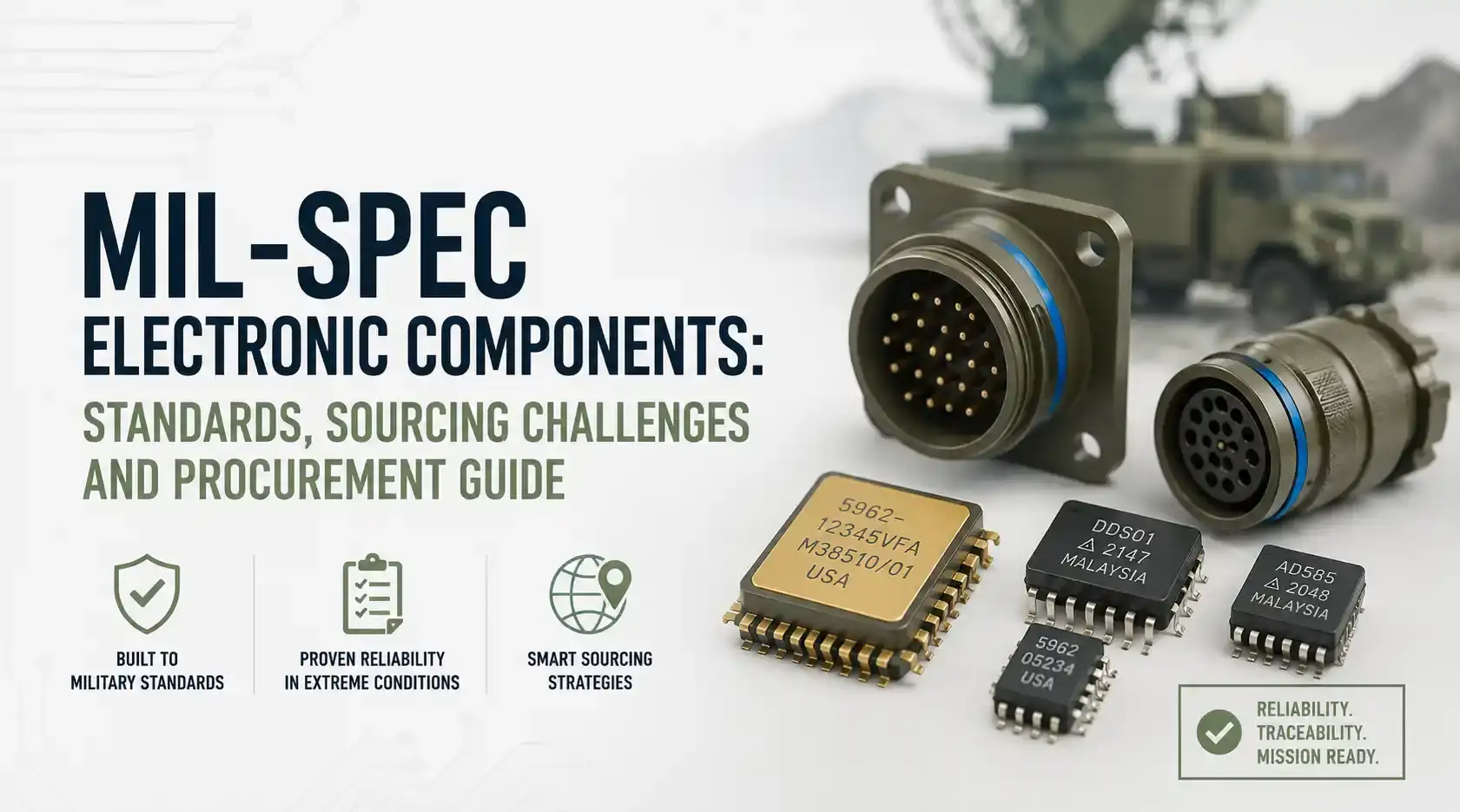
Defense procurement is not like commercial buying. The margin for error is zero, the paper trail is mandatory, and a counterfeit capacitor can ground a fleet. For procurement managers at defense contractors and systems integrators, sourcing MIL-SPEC electronic components means navigating a layer of standards, compliance requirements, and supply chain risks that commercial buyers never encounter.
This guide covers what those standards actually require, how the JAN qualification tiers work, and where the sourcing process gets genuinely difficult. The goal is to give procurement teams a practical reference, not a glossary.
Before getting into sourcing challenges, it helps to understand what the standards actually govern. Three main frameworks: MIL-STD, MIL-SPEC, and MIL-PRF. They are related, but they test different things.
MIL-STD (Military Standard) governs how components are manufactured, tested, and handled. It defines the procedures and testing methods that manufacturers must follow, not just the outcome but the process itself.
A few examples that procurement teams regularly encounter:
MIL-STD-461 covers electromagnetic interference (EMI) testing. Any component going into a platform that operates in a contested electromagnetic environment needs to pass this.
MIL-STD-883 is the main qualification standard for microelectronics. It covers environmental, mechanical, and electrical testing, including temperature cycling, vibration, shock, and moisture resistance.
MIL-STD-1275 deals with electrical characteristics on military vehicles, specifically voltage spikes and transients on 28V DC bus systems. Components that cannot handle those surges will fail in the field.
MIL-STD-1399 covers interface standards for shipboard equipment, including naval power conditions.
MIL-SPEC (Military Specification) governs the physical and material properties of components. This includes dimensional tolerances, material composition, electrical conductivity, and insulation resistance. Where MIL-STD defines how you test, MIL-SPEC defines what the component must be.
Environmental stressors tested under MIL-SPEC include thermal stress, humidity, vibration, shock, and moisture ingress. A component that passes MIL-SPEC inspection has been verified to withstand the physical conditions it will encounter, not just the electrical ones.
MIL-PRF (Military Performance Specification) asks a different question: how should the component function under operational conditions? It is performance-based rather than design-prescriptive.
MIL-PRF-31032, which covered rigid, flexible, and rigid-flex PCBs, is now inactive. MIL-PRF-55110, which covered legacy rigid PCBs, is also inactive. Both have been replaced by updated procurement guidance from the Defense Logistics Agency (DLA). Procurement teams sourcing PCBs for legacy platforms should verify current DLA equivalents before specifying these part numbers in contracts.
JAN (Joint Army-Navy) qualification is a separate but related layer. It applies to specific component categories, most commonly semiconductor devices like transistors, diodes, and integrated circuits. Components that carry a JAN prefix have passed testing requirements beyond the commercial baseline. The tier determines how far beyond.
JAN is the entry-level military qualification. To carry the JAN prefix, a component must pass screening tests covering electrical parameters and environmental exposure. It is not easy to achieve, but relative to the higher tiers, the testing is less intensive.
JANTX adds 100% lot screening on top of JAN qualification. Every device in the lot is tested, not just a sample. The TX stands for extra testing, and that is accurate. JANTX components are required when reliability requirements exceed baseline JAN, typically for ground vehicles, naval systems, and applications where field replacement is possible but undesirable.
JANTXV adds a layer of internal visual inspection to the JANTX screening process. Each device is inspected under high magnification for internal defects: wire bonds, die attach, metallization, and contamination. This inspection happens before sealing. The practical effect is that JANTXV components have a lower infant mortality rate than JANTX, which matters in applications where early failure is as costly as field failure.
JANS is the highest JAN tier and is reserved for space applications. Testing at this level goes further than JANTXV in both scope and rigor. Radiation hardness is evaluated, since space components face ionizing particle bombardment that ground-level testing does not replicate. Temperature cycling ranges are extended to cover the thermal environment of low Earth orbit and beyond.
"JANS-qualified" does not mean a component is suitable for every space mission. Mission-specific requirements from NASA, the DoD, or commercial launch operators may impose additional screening or derating requirements beyond JANS. Procurement teams should verify this with their systems engineering counterparts before finalizing a BOM.
The cost difference between commercial off-the-shelf (COTS) components and their MIL-SPEC equivalents is not arbitrary. A MIL-qualified version of a functionally similar commercial component can cost between 3x and 10x more, depending on the tier and component type. Here is where that cost comes from.
Temperature range is the most cited factor. Commercial components are typically rated for 0°C to 70°C. MIL-SPEC electronic components are rated from -55°C to 125°C, and some extend to -65°C to 170°C. Achieving and verifying that range requires different materials, tighter manufacturing tolerances, and extended qualification testing.
Every MIL-grade component also goes through thermal cycling and burn-in before it ships. Burn-in involves running the component under electrical stress at elevated temperature to catch early-life failures before the part reaches the field. This process takes time and equipment, and that cost is built into the unit price.
Vibration and shock resistance requirements are also substantially higher. Military equipment operates in environments where commercial components would fail within hours. Achieving the required G-force tolerance involves design changes, packaging choices, and testing that commercial production lines do not run.
Finally, the lot traceability and documentation requirements add cost. Every MIL-SPEC component ships with a documented chain of custody from the wafer through final test. That paperwork exists because the government requires it, and producing it accurately takes labor.
Standards compliance is difficult enough. The supply chain complications that come with military-grade components sourcing are a separate problem.
Military platforms have service lives that commercial electronics cycles cannot support. An F/A-18 that entered service in the 1980s may remain operational through the 2030s. The commercial semiconductor used in its original avionics was likely discontinued years or decades ago.
When a component reaches end-of-life (EOL), the manufacturer issues a Product Discontinuance Notice (PDN). Procurement teams that track PDNs can place Last Time Buy (LTB) orders before the manufacturing line closes. Those that miss it face two options: find remaining stock through authorized channels, or fund a redesign.
Obsolete and EOL electronic components are available through authorized distributors with verified supply chains, but availability is finite and declining. For programs with 20-plus year sustainment requirements, a documented obsolescence management plan is not optional,; in many cases it is a contract requirement.
When stock is genuinely exhausted, and no drop-in replacement exists, the defense industry's option is a form-fit-function (FFF) redesign, also called a bridge solution or a form-fit substitution. The replacement part must match the original's physical dimensions, mounting interface, and functional behavior well enough that the platform-level qualification remains valid.
FFF redesigns involving passive components can be relatively straightforward. Redesigns involving custom ASICs or proprietary ICs can cost millions and require re-qualification of the entire subsystem. This is not a hypothetical risk for programs with legacy avionics or shipboard electronics.
The International Traffic in Arms Regulations (ITAR) control the export, re-export, and transfer of defense articles, including many MIL-SPEC electronic components manufactured in the United States. Under ITAR, unauthorized disclosure of controlled technical data to a foreign national, even within a US facility, is a violation.
For procurement teams, the practical implications are significant. Sourcing MIL-SPEC components from non-ITAR-registered suppliers, even inadvertently through a broker chain, creates legal exposure. Distributors who handle ITAR-controlled components must be registered with the US Directorate of Defense Trade Controls (DDTC) and maintain compliance programs. Verifying this registration before awarding a contract is a standard procurement step that is sometimes skipped under schedule pressure. It should not be.
Many MIL-SPEC components have part numbers controlled by the Defense Logistics Agency (DLA). These parts are governed by Standard Microcircuit Drawings (SMD) or Vendor Item Drawings (VID), which define exact form, fit, and function requirements. Substituting a part with a different manufacturer's device, even one that appears electrically identical, may not be acceptable without a DLA-approved qualification.
Connectors and passive components frequently appear in DLA-controlled drawings. Procurement teams should verify whether a required part number is DLA-controlled before approaching alternate sources, because an unapproved substitution can result in contract non-conformance even if the part performs correctly.
Defense procurement requires full traceability from manufacturer to installation. For semiconductors, this typically means lot date code, wafer lot number, and test data. For components sourced outside the original manufacturer's authorized distribution channel, establishing that traceability retroactively is difficult or impossible.
DFARS clause 252.246-7007 requires contractors to maintain a counterfeit prevention plan that includes sourcing only from original component manufacturers (OCMs) or their authorized distributors. Traceability is the mechanism that makes that requirement verifiable. Without it, a procurement team cannot demonstrate compliance during an audit.
Counterfeit electronic components are a documented problem in the defense supply chain. The US Senate Armed Services Committee published findings as early as 2012 identifying hundreds of thousands of suspect counterfeit parts in military systems. The problem has not gone away.
Counterfeit components typically fall into a few categories: remarked parts (lower-grade components remarked to pass as higher-rated devices), recycled pull components (used parts cleaned and repackaged as new), and outright fakes with no genuine die inside. Remarked parts are particularly dangerous because they can pass visual inspection and basic electrical testing while failing under the stress conditions they are rated for.
The risk is highest when sourcing from brokers or the open market. Working with an authorized distributor that sources directly from OCMs and maintains documented traceability is the standard mitigation. AS6081 is the industry standard for counterfeit avoidance in electronic part distribution, and it is worth asking prospective distributors whether they are AS6081-certified.
MIL-SPEC electronic components are harder to source, more expensive, and subject to compliance requirements with real legal and mission consequences. The standards exist because the applications demand them. A component that fails at -40°C on a test bench fails at altitude in winter, and the cost of that failure is not measured in dollars.
For procurement teams, the takeaway is straightforward: source from authorized channels, track obsolescence before it becomes a crisis, and verify ITAR registration and traceability documentation before placing orders. If you are working through a complex sourcing requirement or need component sourcing support for a defense program, contact us to discuss your requirements.
Chip shortages rarely start with anything dramatic. A small uptick in retail demand for phones, c
READ FULLDefense procurement is not like commercial buying. The margin for error is zero, the paper trail
READ FULLIndustrial Automation Electronics: Which ICs Matter for PLCs and SC
READ FULL