Select your Language :

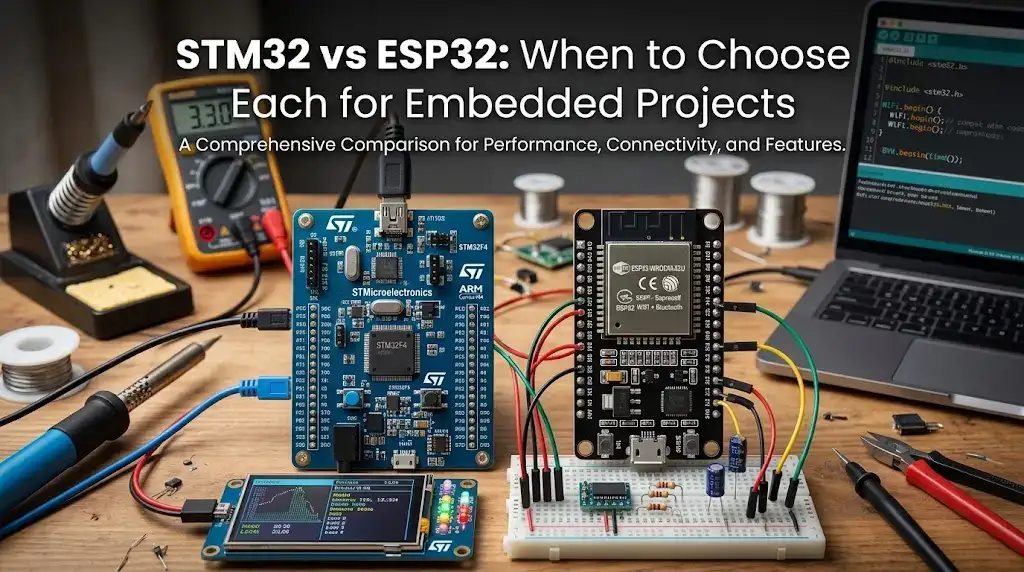
STM32 and ESP32 look interchangeable on a spec sheet, but they are built for different jobs. Picking the wrong one can force a board respin or a second firmware stack late in development. This guide compares them on design focus, real-time behavior, connectivity, peripherals, tools, power, and production life, then ends with a decision list.
If you are also planning procurement, the authentic electronic component sourcing guide covers that side.
STM32 is a family of Arm Cortex-M microcontrollers from STMicroelectronics. It runs from small, low-cost parts to high-performance ones, and it is built around control tasks: timers, analog inputs, wired buses and power management.
ESP32 is a family of system-on-chip devices from Espressif. It includes built-in Wi-Fi and Bluetooth (including BLE). Depending on the variant, the CPU is a single- or dual-core Xtensa or RISC-V design.
The short version: STM32 is a control platform with optional connectivity. ESP32 is a connectivity platform with enough control for many jobs. If you need to verify what you buy, read how to verify authentic STM32 chips before they reach your production line.
STM32 suits work where a missed deadline causes a fault: motor drives, servo loops and closed-loop control with tight timing. Its hardware timers, interrupt controller and DMA let you build firmware with predictable worst-case latency. Predictable timing still depends on your design, including interrupt priorities, memory access, and bus load.
ESP32 runs FreeRTOS and handles many control tasks well. Its Wi-Fi and Bluetooth stacks share the CPU and add timing variation, so it is harder to guarantee tight deadlines while the radio is busy. If you are weighing STM32 against smaller parts, see STM32 vs STM8.
| Factor | STM32 | ESP32 |
|---|---|---|
| Timing predictability | Stronger fit for hard real-time | Variable while the wireless stack is active |
| Motor control | Common in industrial drives | Workable for lighter control loops |
| RTOS options | FreeRTOS, Zephyr, ThreadX, bare-metal | FreeRTOS in ESP-IDF, Zephyr on supported boards |
| Connectivity | Requires separate chips or modules for Wi-Fi and Bluetooth | Built-in Wi-Fi and Bluetooth |
| Power consumption | Very low power use in sleep modes | Higher base power use due to wireless features |
| Software tools | STM32CubeIDE and professional development tools | ESP-IDF and Arduino environment support |
| Cost | Varies widely from simple low-cost to advanced high-end chips | Generally low cost for connected projects |
Choose STM32 if a missed deadline means a system fault or a bad sensor reading. Choose ESP32 if timing tolerance is in the millisecond range and connectivity comes first.
ESP32 has Wi-Fi, Bluetooth Classic, and BLE on the chip, and its SDK includes over-the-air (OTA) update support. For a product that talks to a cloud service, a phone app, or a wireless mesh, this removes a radio module, its board space, and its integration work from the design.
Most STM32 parts have no radio and rely on wired links such as CAN, RS-485, SPI, I2C and Ethernet, or on an external wireless module. Each module adds cost, board area, and firmware work. Some STM32 lines (the STM32WB, STM32WBA, and STM32WL series) include wireless on the chip, so check those before assuming you need an external module.
Choose STM32 when the product talks to other industrial nodes over wired buses. Choose ESP32 when it connects to the cloud or a mobile app. To control cost, see how to reduce BOM cost when sourcing microelectronics.
STM32 parts offer a wide range of peripherals, including multiple timers, ADCs, UARTs, and CAN controllers, and larger packages expose many I/O pins. This suits designs that read many sensors or drive many outputs. Which parts support CAN-FD varies by series, so check the one you plan to use.
ESP32 modules expose a fixed number of GPIOs that varies by variant, and designs that need many I/O lines can run out of pins. ESP32 variants such as the S2, S3, C3 and C6 target different connectivity and performance needs, and they are not pin-compatible with each other.
STM32 also scales across a wide performance range, from entry-level Cortex-M0 parts to Cortex-M7 parts at several hundred MHz. Moving between series usually means rechecking pinouts and peripherals, though the CubeMX configuration tool and shared libraries reduce rework. Plan for the same check on ESP32 variants.
Lifecycle planning belongs here too. Read about component lifecycle management to avoid EOL and production-halt issues before committing to either family.
STM32CubeIDE and STM32CubeMX are free. CubeMX generates peripheral setup code, which speeds configuration for developers new to embedded work. Arm Keil MDK and IAR Embedded Workbench are also supported for teams that already use them.
ESP32 development is usually quicker to start. ESP-IDF is the official framework, and Arduino and PlatformIO are also supported, so teams without deep embedded experience can get a prototype running fast.
STM32 gives teams deeper hardware control when they need it for long-lifecycle industrial products. ESP32 gets IoT prototypes to market sooner. If you are also weighing programmable logic, see FPGA vs microcontroller. When you are ready to buy, read franchise distributor vs independent distributor first.
Both families have low-power modes. The difference is the radio. When active, ESP32’s Wi-Fi and Bluetooth hardware draws far more current than the CPU core alone, so a design that transmits often will use more power than the sleep figures suggest.
STM32 has a range of low-power modes and fits battery-powered sensors that wake on a schedule and don’t need a radio. ESP32’s deep sleep works well when the device sleeps most of the time and wakes only briefly to transmit. In both cases, compare the datasheet figures for your duty cycle and battery, not the headline sleep number.
Memory prices also affect budgets, so watch memory IC price trends as you plan.
Choose STM32 for motor control, servo loops, and closed-loop feedback with tight timing. At millisecond tolerance, either works.
Choose ESP32 for Wi-Fi, BLE, and OTA updates without extra modules. For wired-only designs, or wireless through an external module, choose STM32.
Choose STM32 for long-term industrial deployments and regulated fields such as aerospace, automotive, and medical. ESP32 fits shorter-lived consumer IoT. Check each manufacturer’s longevity commitment for the exact part before relying on either.
Choose STM32 if your team is comfortable with HAL-level, register-level work. Choose ESP32 if speed to market matters and the team is more at home with Arduino-style tools.
Many industrial IoT gateways use both chips. STM32 handles sensors, motor control, and other real-time tasks. ESP32 handles the network connection. This keeps safety-critical control separate from the network stack. The cost is a higher BOM and a second firmware to maintain. For PLC and SCADA projects, see IC selection for PLCs and SCADA systems.
Counterfeit and grey-market parts are a real risk for both families. JennyPenny Tech Limited supplies STM32 and ESP32 parts with traceability documentation. [Confirm and state authorization status here.] Ask any supplier for batch traceability, and verify parts on arrival.
Where can I buy STM32 and ESP32 parts with traceability?
JennyPenny Tech Limited supplies both families. Ask for batch and traceability records with each order.
How do I reduce counterfeit risk when buying microcontrollers?
Buy from a source that provides traceability, and inspect incoming parts. The STM32 verification guide lists what to check.
Does STM32 have built-in Wi-Fi or Bluetooth?
Most STM32 parts do not. The STM32WB and STM32WBA series add Bluetooth LE, and the STM32WL series adds LoRa. For Wi-Fi, STM32 designs normally use an external module.
STM32 and ESP32 look interchangeable on a spec sheet, but they are built for different jobs. Pick
READ FULLAsia Pacific supplies a large share of the world’s semiconductors, but buying from the regi
READ FULLMemory prices are still climbing, though more slowly than a year ago. TrendForce's late September
READ FULL