Select your Language :

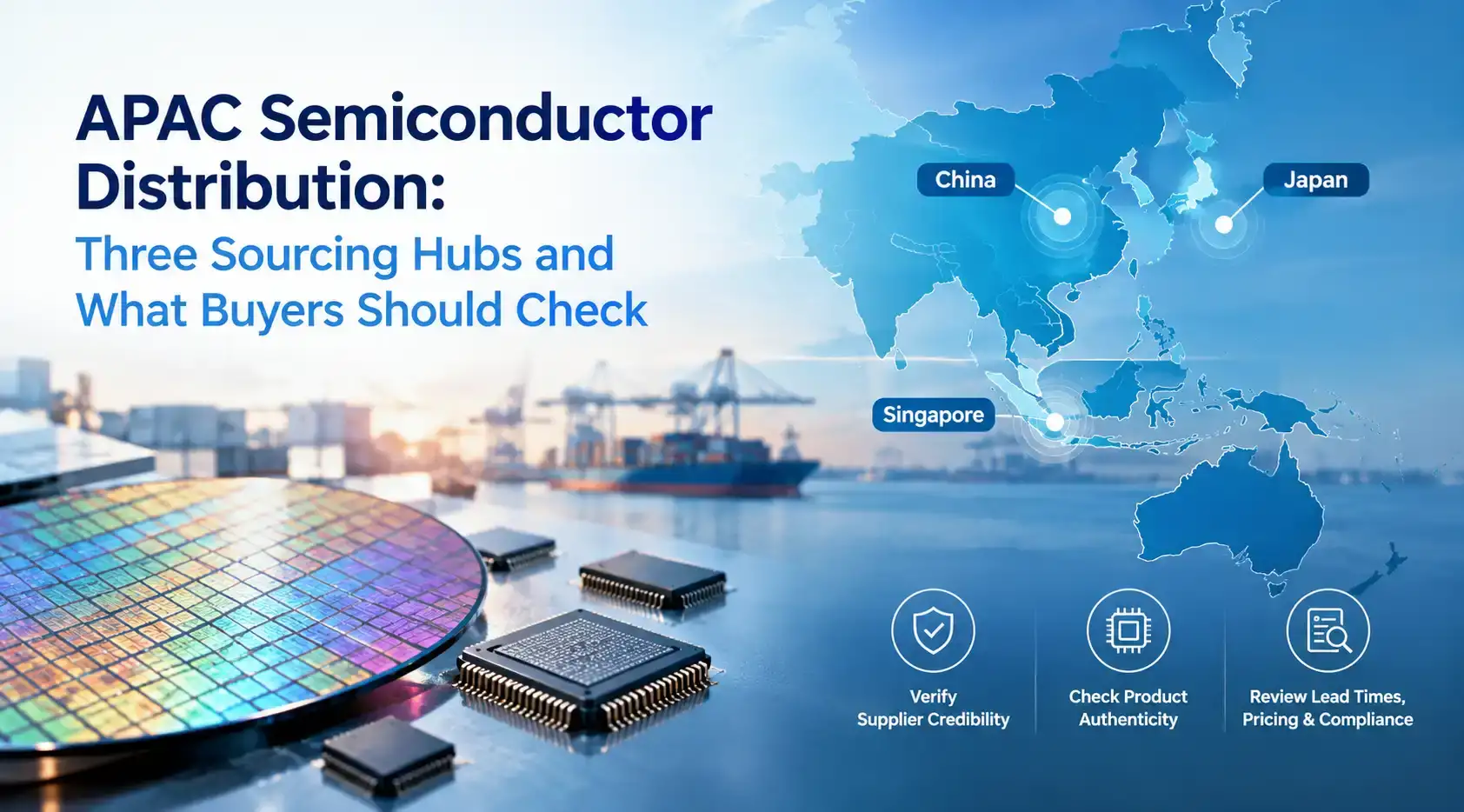
Asia Pacific supplies a large share of the world’s semiconductors, but buying from the region is rarely one transaction with one kind of seller. A component can be made in one country, packaged in another, stored in a third, and sold by a company that has never held it. Buyers in Europe and North America often receive quotes from manufacturers, authorized distributors, independent distributors, brokers, and contract manufacturers on the same RFQ.
A supplier’s address says little about who owns the stock, whether the seller is authorized to sell the part, or when it will ship. Quoted lead times frequently leave out inspection, export processing, and customs clearance.
This post treats APAC as several markets with different strengths and covers three of them: China (mainly Shenzhen), South Korea, and Taiwan. For each hub, it describes what the hub does well, what to verify, and where it fits in a sourcing plan. The goal is to use APAC semiconductor distribution for specific needs, with controls in place and a qualified alternative for every critical part.
Pick the hub after you know the requirement. A buyer who needs Memory for volume production needs a different supplier relationship from one hunting for an obsolete analog device. A team designing around advanced logic has to look at foundry and packaging dependencies before comparing distributor prices.
Typical requirements include:
Working from the part outward is more reliable than choosing a country and fitting every request into it.
A listing from Shenzhen, Hong Kong, Singapore, or Seoul can come from a manufacturer, an authorized distributor, an independent distributor, a broker, a trading company, or a warehouse operator. Each gives you a different view into where the part has been. Hong Kong and Singapore are long-standing trading and logistics hubs, so a quote from either may come from a trading company rather than a maker. Ask who holds the stock before you compare prices.
Shenzhen has one of the densest electronics trading and manufacturing clusters in the world. Buyers use it for parts that franchised channels cannot supply: obsolete and end-of-life components, excess stock, small quantities, and parts caught in allocation. A team facing a line stoppage can sometimes find inventory there that no authorized channel can offer. Buyers get speed and breadth, and they pay for it with extra verification work.
Independent-market purchasing calls for authentication and traceability controls. The problems buyers run into include remarked or relabeled devices, recycled parts, used parts sold as new, mixed date codes, poor packaging, and incomplete chain-of-custody records.
Supplier quality varies widely, and a country of origin does not predict it. A well-established independent distributor with documented inspection can be more reliable than an unfamiliar intermediary anywhere. What matters is whether you can find out who owns the inventory, where it is stored, how it was obtained, and what testing was done.
Many buyers ask independent suppliers to work to AS6081, the counterfeit-avoidance standard for distributors, and use AS6171 test methods and IDEA-STD-1010 inspection criteria to set acceptance rules. AS5553 covers the same problem from the buyer’s side.
A Shenzhen supplier may quote immediate availability. The phrase can describe several different situations:
Before issuing a purchase order, confirm the exact quantity, warehouse location, date codes, packaging, inspection timeline, and dispatch date.
Use Shenzhen as a spot-market resource rather than an automatic substitute for authorized distribution. It suits emergency purchases, obsolete parts, excess inventory, and short-term supply gaps. For parts going into regulated sectors, set up a vetting process: a sample order, independent inspection, authenticity testing, and written acceptance criteria.
South Korea is strong in Memory, where Samsung and SK hynix lead DRAM and NAND production, and in OLED display driver ICs from Samsung System LSI and LX Semicon. Buyers looking at display drivers should also read the Taiwan section, because a large share of driver IC design sits there.
The main risk is concentration. Buyers depend on a few large manufacturers and approved channels. When demand is strong, allocation, capacity limits, product-generation changes, and channel restrictions decide who gets parts, and smaller buyers can be pushed behind large strategic accounts.
Memory and display lead times can change quickly. A part that is easy to find in a soft market can become hard to get when demand rises. When a supplier quotes a lead time, ask which of these it is:
Treat a quote as firm only when the supplier can show a documented allocation or a confirmed inventory position. For background on how memory pricing and availability move, see our article on memory IC price trends.
Even with an established Korean supplier, confirm authorization status, product revision, lot and date-code records, packaging condition, country of origin, end-use requirements, and export eligibility. Product families in Memory and display change fast, and a compatible replacement can still need firmware updates and, in regulated sectors, requalification.
South Korea works best as a specialized source for Memory and display parts. It is a poor fit as a general alternative for every semiconductor category. A workable plan has direct or authorized relationships for planned production, prequalified alternate suppliers, approved substitute components, allocation monitoring, buffer stock for critical memory parts, and a regular review of how many parts depend on the same manufacturer.
Taiwan is home to TSMC and a dense network of chip designers, foundries, packaging houses, test providers, and materials suppliers. It is also a major source of display driver IC design, with Novatek, Himax, and Raydium among the active companies. That makes it a second place to look, alongside Korea, for display driver supply.
Access to this ecosystem does not let a European buyer purchase foundry capacity or skip the existing manufacturer and distributor relationships. What a buyer can get depends on who owns the product, whether it is qualified, and how the channel is set up.
Taiwan-linked sourcing carries concentration risk when a part depends on one foundry, one process technology, a small group of packaging or test providers, a narrow set of qualified manufacturers, or a design that cannot be moved easily. Without a qualified alternate design, changing suppliers means substantial engineering work and, in regulated sectors, requalification. Buyers also weigh natural hazards and geopolitical risk when they plan for continuity.
Taiwan lead times follow foundry capacity, wafer allocation, product complexity, packaging requirements, test capacity, customer qualification, and demand from fast-growing technology sectors. Ask suppliers to break a delivery date into stages. A finished-goods date can depend on wafer fabrication, packaging, testing, export processing, and distributor handling, and any one of them can slip.
Treat Taiwan as the main source of advanced semiconductor capability without putting the whole supply chain inside one ecosystem. Buyers can:
For critical devices, adding a second distributor in Taiwan rarely solves the problem, because both may rely on the same fab. A qualified alternate design, a different manufacturing route, or a redesigned product architecture gives better protection.
These issues apply to all three hubs, so they are covered once here.
Tariffs matter most to buyers importing into the United States. Chinese semiconductors on the listed tariff codes already face a 50% Section 301 tariff, a separate Section 232 tariff of 25% on certain semiconductors was announced in January 2026, and an additional Section 301 duty on Chinese semiconductors is scheduled to start on June 23, 2027. Rates, scope, and exemptions change, so confirm the tariff classification with a customs broker before you price a quote.
Export controls affect buyers who resell as well as those who manufacture. Wholesale and distribution buyers should review:
Review is most important for parts intended for advanced computing, aerospace, defense, telecommunications, and other regulated uses. Screen every counterparty, including intermediaries, against restricted-party lists such as the US Entity List before you place an order. For regulated end uses, our guide to MIL-SPEC electronic components covers the standards side.
| Hub | Main strength | Main procurement risk | Best use |
|---|---|---|---|
| China, especially Shenzhen | Spot-market access to surplus, obsolete, and hard-to-find parts | Counterfeit exposure, uncertain inventory, traceability gaps | Emergency and independent-market purchases with added controls |
| South Korea | DRAM, NAND, and OLED display driver ICs | Allocation, manufacturer concentration, demand swings | Memory and display sourcing |
| Taiwan | Foundry, advanced logic, packaging, testing and driver IC design | Capacity concentration, technology controls, qualification barriers | Advanced logic and technology-intensive products |
Spreading orders across countries does not reduce risk if two suppliers in different countries rely on the same manufacturer, foundry, packaging provider, inventory pool, or shipping route. Start by listing your current suppliers by country, manufacturer, distributor, foundry, packaging and test provider, logistics route, and product family. The list shows where exposure is real.
Next, give each hub a defined role: China for Emergency, surplus, and obsolete stock, South Korea for memory and display parts, and Taiwan for advanced logic and foundry-linked products. Then prequalify alternate suppliers before a shortage starts. During a disruption, there is rarely time to check a new supplier’s documentation. Our article on semiconductor shortage cycles explains how those periods tend to unfold.
A sourcing plan holds up when it combines several kinds of diversity: more than one region, more than one channel, qualified alternate components, traceability controls, export compliance, and inventory levels that match real lead times.
JennyPenny Tech is a Hong Kong-based authorized distributor of electronic components. Its range includes memory ICs and display driver ICs. Buyers can send a bill of materials through the site for a quotation and discuss availability, lead times, and documentation before placing an order.
Asia Pacific supplies a large share of the world’s semiconductors, but buying from the regi
READ FULLMemory prices are still climbing, though more slowly than a year ago. TrendForce's late September
READ FULLChip shortages rarely start with anything dramatic. A small uptick in retail demand for phones, c
READ FULL