Select your Language :

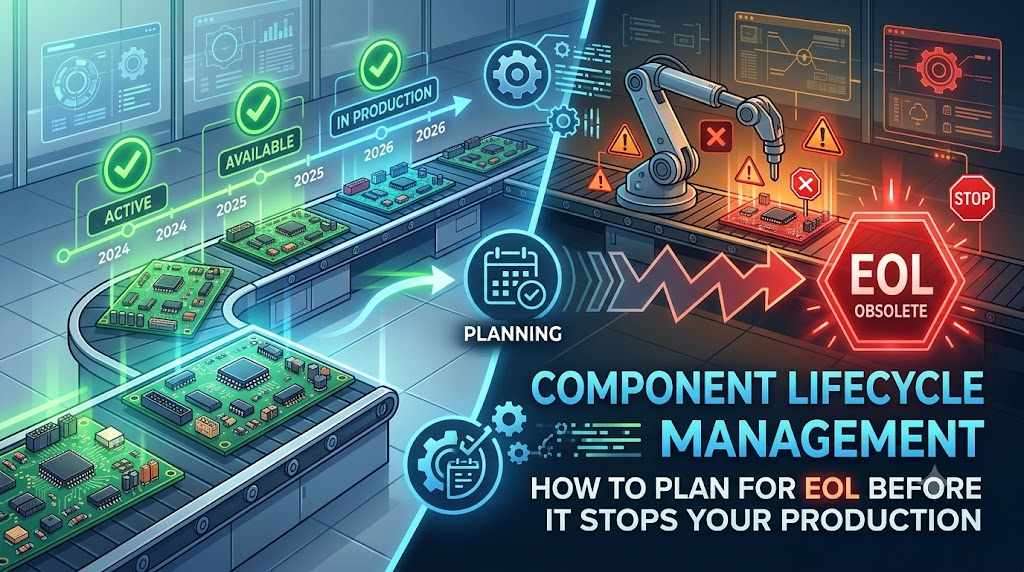
Just a slight change in an ADC, memory IC, or sensor can cause massive disruption for a device manufacturer. When making a BOM, companies have to make sure they have all the information regarding the sourcing of all the microcomponents for production. What if there is an ignored PDN, and now the company will have to face a massive production halt? It could be worse if the company is expanding its production, and now there is a final declaration of component obsolescence from its manufacturer?
It is a nightmare for every device manufacturing company, and the only way to mitigate such a situation is through component lifecycle management EOL planning. Without this proactive planning, companies may face forced redesign if the components become obsolete or production is stopped suddenly. That is a huge financial loss, and procurement managers and hardware engineers know the pain. In this blog, such procurement managers and hardware engineers will find solutions to tackle component EOL and obsolescence challenges.
The lifecycle stages of electronic components are introduction, growth, maturity, decline, exit, and obsoletion. Almost every product has this lifecycle stage, and companies have to strategize production accordingly. Component lifecycle management EOL planning is mandatory if companies do not want to face massive financial damages. These financial damages are sudden changes in the design, urgent orders of EOL parts, and wasted labor costs.
This is why companies have to keep an eye on the product lifecycle to make sure memory ICs like IC MRAM, FRAM, and RAM are available. The same is true for ADCs like precision operational amplifiers that contribute to various types of machinery. What industries have to do is keep an eye on the below product lifecycle stages.
Any component that is active in the industry or is at maturity level is easy to source. Manufacturers provide as many quantities as buyers need. Microcomponents like MOSEFTs and industrial sensors are in high demand during their maturity levels or growing stage. So, neither manufacturers nor buyers have any issue at this stage.
NRND components are “Not Recommended for New Design” components. Every product gets changes and advancements that create ways for advanced and more cost-effective components. In this condition, components that were once active and in high demand start becoming replaceable. Manufacturers realize that new machines need slightly different components for faster performance at lower cost. That is the biggest challenge in the technological world: every new product demands faster components. This is why the current and older components become NRND components.
Then the company moves to an EOL announcement. This is the stage where manufacturers of microcomponents have to decide to limit the production of precious components that might be less compatible with advanced devices. When manufacturers announce EOL via PDN (Product Discontinuance Notification), many companies have to prepare for an end of life component strategy. It is a proactive approach where new devices require more advanced components, and manufacturers have to analyze the EOL cycle of some specific components. The entire production may face disruption if there is no backup of those components.
LTB or “Last Time Buy” is the final date of placing an order before production is permanently stopped. Companies issue PCN (Product Change Notice) or PDN (Product Discontinuance Notice) to alert buyers. Device manufacturers have to make sure they have enough last time buy electronics to keep the production going. Sudden shortage of components can cause massive disruption and production shutdown. If buyers buy less than the required quantity, they face a shortage soon. If they buy more than required, they face the risk of excessive expenditure on a few microcomponents.
LTS or last-time-ship is the final date of the last batch of components shipped by the company. A manufacturer issues final notice regarding the last batch, which is usually 6 months before the component becomes obsolete. In simple words, it is a notification that shows a cutoff time regarding the last shipment of microelectronic components when the production is about to become obsolete.
Once that period of LTS is over, that component becomes obsolete. That means there is no active production or any kind of production available now. This is where device manufacturers have to do component obsolescence management. This is the point when buyers have to realize that either they will have to do an expensive redesign of the component, or look for an EOL component supplier like HK JENNYPENNY Tech Limited.
The biggest threat device manufacturers face is BOM obsolescence risk. This risk forces device manufacturers to go either for immediate redesign of the product, find expensive alternates, or halt production. The market value of those components is over, and buyers have to manage the risk.
As soon as manufacturers release PCN and PDN, there is a panic-like situation except for a few companies. Those few device manufacturing companies have proactive component lifecycle management EOL planning. They analyze and forecast the impact of PCN and PDN months in advance. These PCN and PDN can seize production, force to change the existing designs of products, and even cause delays in supply. The financial cost is very high.
In order to tackle the massive impact of PCN PDN electronics, buyers need real-time tracking of PCN. There are a number of software solutions that allow companies to keep real-time information about PCN components. As soon as manufacturers release these notifications, software provides updates, so buyers can go for alternatives. Some advanced software may offer features to find alternatives to match the BOM.
Such software gives timely alerts to companies regarding the latest PCN and PDN. As a result, they face less damage, less labor cost, and sudden need for changes. It also helps them tackle sudden BOM obsolescence risk.
To avoid BOM obsolescence risk, active BOM tracking with real-time effects is required. Real-time updates will provide updates about PCN to avoid mishaps in production and the need for emergency production from a single source.
What buyers do is get early updates about EOL announcements to get large stocks of LTB to reduce the shock of component changes.
JEDEC standards create compatibility between different microelectronic parts from different manufacturers. They decide the memory rules, sizes, coatings, and everything about microchips. As a result, buyers get ease of selection of microcomponents, especially when they source authentic components from an authorized distributor. HK JENNYPENNY Tech Limited is an authorized distributor that can source from authentic manufacturers who comply with JEDEC standards. As a result, buyers who want to continue production with EOL components source compatible components from it.
There are some proactive ways to make an end of life component strategy. It requires multiple methods to reduce the maximum damage.
There is a huge risk of counterfeit microcomponents in EOL component sourcing. There are some suppliers who do e-waste recycling to redistribute with new labels and engraving. Beware of such counterfeit practices because they will lead to poor performance, zero traceability, less compatibility, and risk of damaging products and your brand.
What you can do to avoid it is source authentic obsolete or EOL components from an authorized distributor. HK JENNYPENNY Tech Limited is one reliable name in the industry.
You are about to get some strategies that are proactive, and they help many companies. They help companies in component lifecycle management EOL planning to mitigate financial risk.
Not making proactive plans can lead anyone to disruptions. In the high-tech industry of microelectronics, manufacturers have to be active in deciding the product lifecycle. The way the industry is advancing, the rapid change in technology creates challenges for device manufacturers. The biggest risk is EOL and obsolescence in component production. Such discontinuation or change in components can cause massive disruption for device manufacturers, and they have to face massive financial costs. One of the ways to reduce the damage is to have a backup of EOL components from authorized distributors like HK JENNYPENNY Tech Limited.
Chip shortages rarely start with anything dramatic. A small uptick in retail demand for phones, c
READ FULLDefense procurement is not like commercial buying. The margin for error is zero, the paper trail
READ FULLIndustrial Automation Electronics: Which ICs Matter for PLCs and SC
READ FULL