Select your Language :

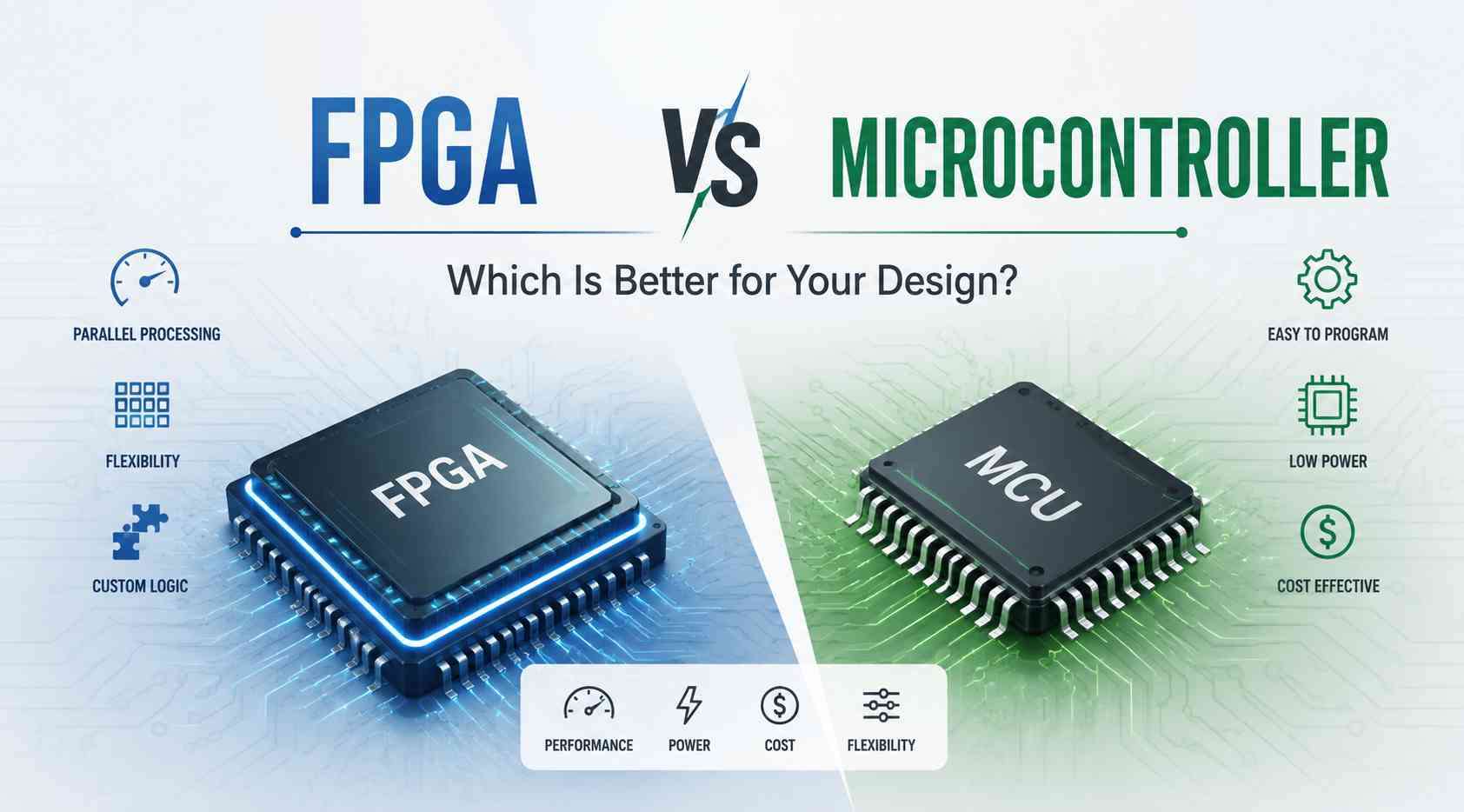
FPGAs and microcontrollers solve different problems. An FPGA implements custom digital logic in parallel hardware, ideal for deterministic, high-speed, or custom-protocol workloads. A microcontroller runs sequential code on a fixed CPU, ideal for low-cost, low-power, control-oriented designs. Choose FPGA when your design needs true parallelism or custom hardware acceleration. Choose an MCU when unit cost, power efficiency, and development speed matter more.
You have a new design on your desk, and you are setting the requirements for the final product. During this stage, you face one of the most consequential early decisions in any embedded project: do you build around an FPGA or a microcontroller? Get this right, and everything from that point flows smoothly. Get it wrong, and you are looking at costly redesigns, blown timelines, and a product that never quite performs the way it should.
Most comparisons you'll find online read like spec sheet battles: clock speed versus logic elements, power draw versus I/O count. Those numbers matter, but they're surface-level details. They don't tell you which technology actually fits your design problem.
This guide walks through the architectural differences that actually matter, maps out where each technology wins, breaks down development time and total cost of ownership, and gives you a practical framework you can use right now to make a confident decision.
Understanding FPGA architecture versus MCU architecture isn't about memorizing block diagrams. It's about grasping two fundamentally different philosophies of computation.
A microcontroller executes instructions sequentially on a fixed CPU. Even with multiple cores and peripherals, the fundamental model stays the same: your code runs one instruction at a time, in order, through a pipeline. Everything is software. The hardware was decided for you at the factory.
An FPGA takes the opposite approach. Instead of running instructions on a fixed processor, the engineer describes the hardware itself using a hardware description language like VHDL or Verilog. You're not writing a program for a chip. You're designing the chip. You have access to thousands of configurable logic blocks, lookup tables, and routing resources that let you build custom digital circuits tailored to your exact workload.
This difference affects performance directly. A microcontroller handling a high-speed data stream has to service interrupts, manage buffers, and context-switch between tasks. Each step introduces latency. An FPGA can process that same stream in dedicated hardware, in parallel, with deterministic timing down to the nanosecond. There's no instruction fetch and no task scheduling. The logic runs.
| Computation Approach | Performance Result |
| Microcontroller: Executes instructions sequentially on a fixed CPU. Hardware is predetermined at the factory. All logic runs as software through a pipeline. | Flexible and easy to program, but introduces latency from instruction fetch, interrupts, and context switching. Best suited for step-by-step control tasks. |
| FPGA: Implements custom hardware circuits described in HDL. Thousands of configurable logic blocks operate in parallel. No instruction cycle. | Delivers deterministic, nanosecond-level timing and true parallel throughput. Ideal for high-speed data processing and custom logic. |
Here's the misconception to avoid: an FPGA is not just a faster microcontroller. It's a different category of computing entirely. Comparing them on clock speed alone misses the point.
There are design problems where an FPGA isn't just a better option. It's the only viable option.
If your design needs to process multiple data channels simultaneously, an FPGA lets you instantiate dedicated hardware paths for each one. A medical imaging system processing data from dozens of sensor channels at once can't afford to serialize that workload through a single CPU. An FPGA handles it natively.
If your algorithm doesn't map neatly onto standard instruction sets, you can build a custom pipeline in silicon. Digital signal processing, cryptographic acceleration, and real-time video encoding are common workloads that benefit from this approach.
High-speed I/O and protocol flexibility give FPGAs a decisive edge in sectors like telecom, aerospace, and industrial networking. Modern FPGAs support multi-gigabit transceivers and can implement virtually any protocol in hardware. If your design talks to a nonstandard interface or needs to bridge multiple protocols at once, an FPGA handles it easily.
ASIC prototyping is one of the FPGA's strongest advantages. Before committing to a full custom silicon tape-out, engineering teams routinely validate their designs on FPGA platforms. The cost of an ASIC respin runs into the hundreds of thousands of dollars. Catching a design flaw on an FPGA first isn't optional. It's standard practice.
Microcontrollers dominate for equally compelling reasons, just different ones.
Cost-sensitive, high-volume production is where MCUs shine brightest. A capable 32-bit microcontroller can cost under a dollar at mass-production economies of scale. An equivalent FPGA might cost 10 to 50 times more. When you're building 100,000 units of a consumer device, that difference becomes too big to ignore. It's the difference between a viable product and a failed one.
Reading sensors, running control loops, managing communication stacks, handling user interfaces: these are tasks that execute step by step, and a well-chosen microcontroller handles them efficiently. You don't need custom hardware to read a temperature sensor every hundred milliseconds.
The ARM Cortex-M ecosystem alone gives you access to mature IDEs, extensive libraries, and real-time operating systems. Widespread familiarity with C, backed by a global talent pool of engineers, makes execution faster and product launches quicker. This is difficult to replicate with FPGAs, where the talent pool and expertise are far more limited.
Modern MCUs can run for years on a coin cell. They wake on interrupt, process briefly, and drop back to nanoamp sleep states. FPGAs have improved in power efficiency, but they generally can't match a purpose-built MCU for ultra-low-power battery applications.
Microcontroller development is familiar territory for most embedded engineers. You write in C or C++, compile, flash, and debug with a JTAG probe. Iteration cycles are measured in minutes, and the ecosystem of libraries and community support means you rarely build anything from scratch.
FPGA development runs on a different rhythm. You describe hardware in VHDL or Verilog, simulate the design, synthesize, place and route, then test on hardware. Debug cycles are longer, simulation becomes a critical skill rather than an optional step, and the learning curve for engineers coming from a software background is steep.
This doesn't mean FPGA development is slow. Experienced FPGA engineers move quickly. But if your team has never worked with an HDL before, you need to account for ramp-up time in your project plan. Hiring or contracting FPGA engineers is also more expensive and harder to find than MCU talent.
The practical question to ask: does your team have the skills, or can you acquire them within your timeline and budget?
Unit cost gets all the attention, but total cost of ownership tells the real story.
For microcontrollers, the cost picture is simple: low unit price, free or low-cost toolchains, minimal licensing fees, and a large community for troubleshooting. The risk of component obsolescence exists, but the market for popular MCU families is deep and stable.
For FPGAs, the cost structure is more complex. Unit prices are higher, especially for parts with large logic counts or high-speed transceivers, and some vendor toolchains carry licensing fees for advanced features.
FPGA vs microcontroller cost comparison at the component level is only part of the equation. You also need to factor in longer development cycles and the cost of specialized engineering talent. Board design for FPGAs can also be more complex, since it needs to accommodate power and signal integrity requirements.
That said, an FPGA can replace multiple discrete components on a board. If your design would otherwise require a microcontroller plus dedicated DSP chips plus custom interface logic, consolidating into a single FPGA can reduce total BOM cost and board complexity.
Key takeaway: don't compare chip prices in isolation. Compare the full system cost, including engineering hours, tooling, board design, and long-term maintenance.
Run through these five questions before you commit:
| Decision Factor | FPGA | MCU |
| Parallel processing | Excellent | Limited |
| Unit cost at volume | Higher | Lower |
| Development speed | Slower ramp-up | Faster onboarding |
| Power efficiency (sleep) | Moderate | Excellent |
| Custom logic | Full flexibility | Fixed peripherals |
| Toolchain maturity | Specialized | Broad and mature |
| High-speed I/O | Multi-gigabit | Standard peripherals |
When to use an FPGA versus a microcontroller isn't always a black-and-white choice. Modern SoC devices like Xilinx Zynq and Intel Cyclone V combine an ARM processor with FPGA fabric on a single chip. STM32 and Microchip PIC32 remain common choices on the pure MCU side, while Lattice ECP5 and AMD Artix serve as accessible entry points into FPGA design. If your design needs both sequential control logic and custom parallel hardware, a hybrid approach gives you the best of both worlds without doubling your board complexity.
Is an FPGA more expensive than a microcontroller?
Yes, at the unit level. A capable 32-bit microcontroller can cost under a dollar at mass-production scale, while an equivalent FPGA can cost 10 to 50 times more.
Can an FPGA replace a microcontroller?
An FPGA can replace an MCU for parallel or custom-logic workloads, but it isn't a drop-in substitute for sequential control tasks where cost and power efficiency matter more.
What is a hybrid FPGA-MCU chip?
A hybrid SoC, such as the Xilinx Zynq or Intel Cyclone V, combines an ARM processor core with FPGA fabric on a single chip. It lets a design run sequential control logic and custom parallel hardware without needing two separate chips.
Which is better for a battery-powered product, FPGA or MCU?
A microcontroller is almost always the better choice for battery-powered products. Modern MCUs can run for years on a coin cell by dropping into nanoamp sleep states between tasks, a level of power efficiency FPGAs generally can't match.
Do I need to know VHDL or Verilog to work with an FPGA?
Yes. FPGA development requires describing hardware in a hardware description language such as VHDL or Verilog, simulating the design, then synthesizing and routing it onto the chip. This is a different skill set from writing C for a microcontroller, and it has a steeper learning curve for engineers coming from a software background.
The FPGA vs microcontroller decision isn't about which technology is better in a head-to-head comparison. It's about which one is the more feasible fit for your specific circuit design constraints, your team's capabilities, your production volume, and your budget.
Taking this decision feels stressful because it is. But you don't have to guess. Use the framework above, run your requirements through it honestly, and the right answer will usually become clear on its own.
If you're still on the fence, prototype both paths early. A week of exploratory development can save you months of rework later.
Have questions about a specific design scenario? Reach out directly. We're happy to help you think it through.
Chip shortages rarely start with anything dramatic. A small uptick in retail demand for phones, c
READ FULLDefense procurement is not like commercial buying. The margin for error is zero, the paper trail
READ FULLIndustrial Automation Electronics: Which ICs Matter for PLCs and SC
READ FULL