Select your Language :

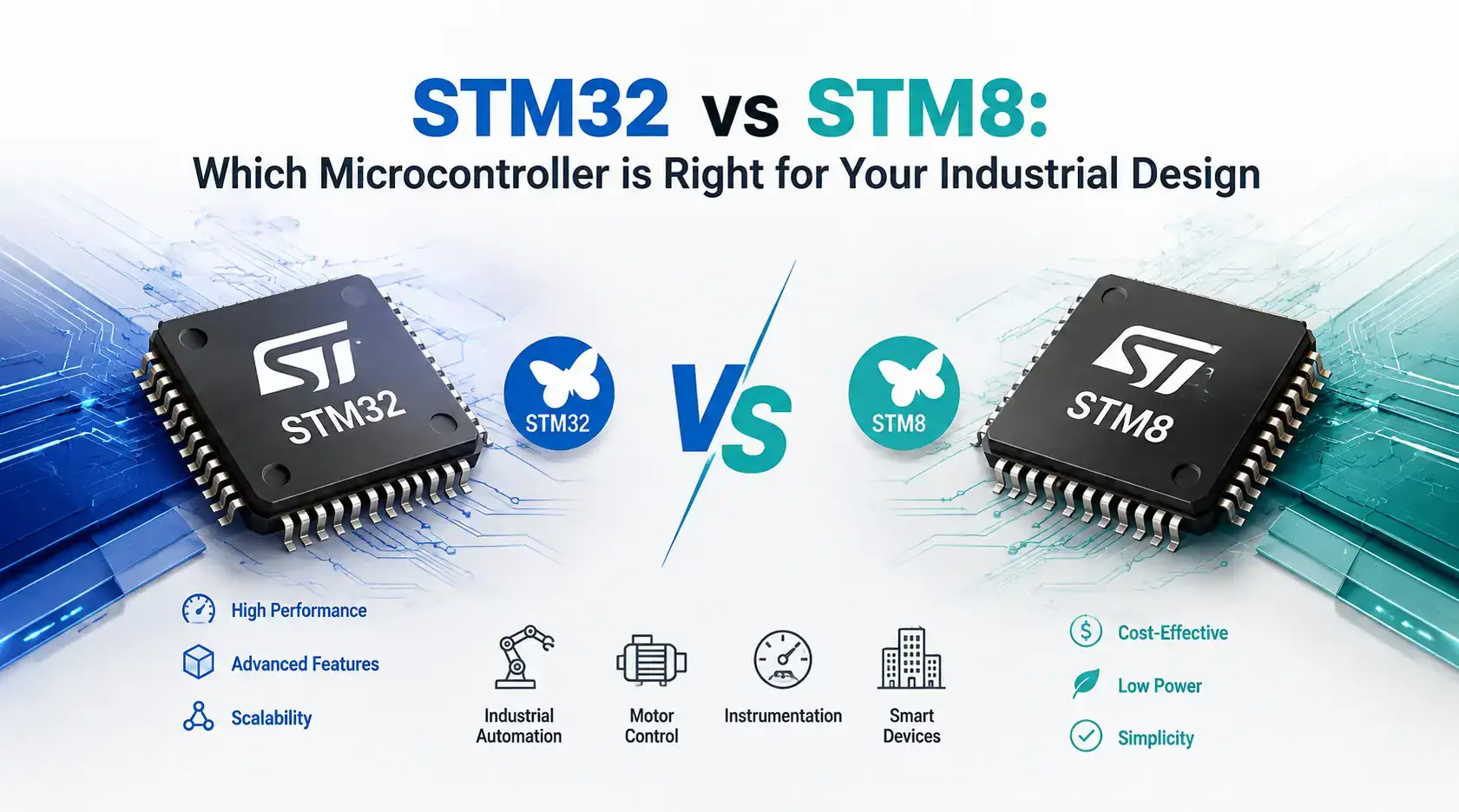
STM8 is an 8-bit, low-cost microcontroller best for simple, low-power devices, while STM32 is a 32-bit ARM Cortex-M microcontroller built for complex, high-speed industrial and IoT applications. STM32 costs roughly 6 times more than STM8 but supports far greater memory, connectivity, and processing power.
Choosing a low-powered microcontroller for a high-powered application will be incompatible. Likewise, choosing a high-powered microcontroller for a low-powered device will be problematic. The selection of microcontrollers decides how well a device will perform. Any flaw in the selection can compromise the core functions of any device. When choosing between STM32 and STM8 microcontrollers, you need to know the core differences. These include flash memory, RAM, clock speed, peripheral set, architecture, and limitations. In this STM8 and STM32 selection guide, you will find which one is ideal for its respective device. One is best for low-cost operations, and the other is best for advanced operations. Your selection matters here, and this guide will help you with it.
It is part of the STMicroelectronics family and supports the fundamental functions of any device. Here's what defines STM8 in this comparison.
First of all, it is the most basic and the most cost-effective microcontroller compared to STM32. It is an ideal choice for applications where companies do not need high or even medium memory. All they need is STM8 microcontrollers, which run on the least power.
For instance, you will find the STM8SXXX series for basic entry-level applications. This series is an ideal choice for simple and basic devices like watches, electric toothbrushes, etc. Then comes the STM8LXXX series for ultra-low-powered applications. These microcontrollers provide low-cost support for devices that need the least power for basic operations.
Then comes the STM8AXXX series for automotive applications, which is more powerful than the others. Still, these applications require less power and memory to run, and the STM8AXXX series is compatible with them.
To better understand the working capacity of STM8 microcontrollers, you need to know about their flash memory. The flash memory limit of STM8 microcontrollers is between 4 KB and 128 KB. Many home, commercial, and industrial devices need minimal power and memory to run. They need STM8 microcontrollers to run the most basic operations at low cost. Low-power sensors and drivers do not need higher-power microcontrollers. They need flash memory between 4 KB and 128 KB, and STM8 is a compatible choice. It is cost-efficient in every way possible.
Lots of devices in industry and even in the home need the lowest possible RAM to work. STM8 microcontrollers are compatible components that provide a RAM range between 1 KB and 6 KB. That is a good range for devices that need cost efficiency in basic operations. The overall cost of production also drops because of these cheap components. They provide basic support for low-power home, commercial, and industrial devices.
The clock speed of STM8 microcontrollers is 24 MHz, which is really excellent. At this clock speed, devices can perform efficiently. What makes it better in this term is the cost of the component and the performance level. Industries install microcontrollers like STM8 to run operations at high oscillation speed or clock speed.
The operational cost is also not high, since STM8 microcontrollers are among the most cost-effective options. The timing pulses and execution rate are high enough to provide desired results. Every operation from input to output is highly coordinated because of this clock speed.
STM8 microcontrollers are compatible with an ecosystem and development tools like ST Visual Develop. This basic software provides full compatibility for writing and building code, along with testing it. This code meets the requirements of STM8 microcontrollers. It has auto-completion and text editor features that make the applications easier.
However, the ecosystem is very small in STM8 because it is compatible with small-size devices where one can not use large boards. Its compact design and low-power compatibility make it compatible with small ecosystems.
The architecture of STM8 microcontrollers is an 8-bit STM8 core. It is compatible only with basic arithmetic and logical operations and local variable management. It contains an 8-bit primary accumulator, 16-bit index registers (X and Y), and a 16-bit stack pointer.
Its peripheral set includes USART, I2C, LIN UART, CSS, ECC, etc. Independent Watchdogs and a clock security system are among the main peripherals that make STM8 a suitable choice for ultra-low-power applications.
Also, the pin count is very low. It makes STM8 microcontrollers very cost-effective in terms of cost-per-pin. The average price per pin is about 1/6 of an STM32, which makes it very cheap for the budget.
There are some limitations of STM8 microcontrollers. Since STM8 microcontrollers are suitable only for very low-cost and small-ecosystem conditions, their limitations are related to these conditions. STM8 microcontrollers have a less competitive ecosystem for handling challenging tasks. The biggest disadvantage of these microcontrollers is that they can not handle complex and challenging tasks. They can only support basic, simple tasks in basic devices. As an ecosystem becomes more complex, STM8 microcontrollers become incompatible with it.
Then comes the second part of the comparison. It is an STM32 selection guide that will help you understand STM32 microcontrollers. They are based on ARM Cortex-M core microprocessors. They also operate at low cost and low power, but there are some differences. The difference is in efficiency level and application size.
In detail, there are different series of STM32 microcontrollers for each range of applications. The STM32C, STM32F, and STM32L series are for basic or mainstream applications where 512KB and 1MB RAM compatibility is needed.
Likewise, STM32U and STM32L series are for ultra-low operations where up to 1 MB RAM is needed. If we move further, the STM32F, STM32H, and STM32N series are for high-speed applications where up to 4 MB RAM is compatible. Then the last one is the STM32W series, which is suitable for wireless applications.
The flash memory limit of STM32 microcontrollers is higher than that of STM8. The reason is clear, and that makes it suitable for secondary-level applications. The flash memory of STM32 microcontrollers starts from 32 KB and reaches 2 MB. Due to this higher flash memory, it performs tasks faster than STM8.
That means not all devices need low-power consumption, and STM32 supports higher capacity. Wi-Fi, Bluetooth, and RFID applications require higher power than basic operations. One can not rely on less flash memory than the one provided by STM32. These secondary applications need more flash memory to function efficiently.
The RAM range of STM32 microcontrollers is between 4 KB and 256 KB. Since these microcontrollers support fast operations, they have a higher RAM range. This helps them perform operations swiftly without the risk of glitches and failures. Many industrial and residential devices include wireless connectivity, and STM32 supports them.
Moreover, they support industrial scanners, printers, motor drives, and HVAC systems. All these machines need consistent performance in data conversion and operations delivery. STM32 also supports sensitive battery-powered electronics, especially where low-powered microcontrollers are needed.
The clock speed of STM32 microcontrollers is between 16 MHz and 1600 MHz. This clock speed is suitable for extensive operations. All the industrial machines that need low and ultra-low power for basic and advanced operations need STM32 microcontrollers. Countless wireless and monitoring devices need something like STM32 microcontrollers. Their compatibility is very high for fast-speed data conversion from sensors to delivery via motors. So, one can rely on these types of microcontrollers when things advance to a higher level.
Since flash memory and RAM capacity are higher, STM32 microcontrollers support a larger ecosystem. They also support multiple programming languages, providing a wide-ranging solution. They also support different programming tools and fast embedded systems for greater efficiency.
They are compatible with ecosystems and development tools like STM32CubeIDE and STM32CubeMX for code editing. They also support GCC compilation for complex operations. STM32 is a faster microcontroller for all the complex operations that are not possible with STM8. Their voltage range is from 2 V to 3.6 V, supporting low-powered operations with advanced features.
Likewise, if we look at the architecture of STM32 microcontrollers, it is a 32-bit ARM Cortex-M. This compatibility makes it compatible with peripherals like USB, SDIO, timers, ADCs, UARTs, I2C, SPI, and CAN. Other peripherals enable advanced options in household, commercial, and industrial devices.
Many devices have additional features, and STM32 can support them. There is no worry regarding memory and power consumption since these components are compatible in both ways. Industries install them for complex operations and a wide range of peripherals. Thus, the number of outputs increases along with efficiency.
However, you need to know some limitations of STM32 microcomponents. They are not suitable for resource-limited applications. Also, their cost per pin is higher than that of STM8. As a result, the overall system becomes much more costly if you are looking for a low-cost project. Until you need higher efficiency for complex operations, it might be costly to choose STM32 for low-powered and basic applications. Also, they are not suitable for multi-channel processing because they need many DSPs.
Because STM32 demand is so high across industrial and IoT applications, it's also a common target for counterfeit and remarked parts, particularly in the F1 and F4 series. Before committing to a design, it's worth knowing how to verify authentic STM32 chips so procurement isn't caught off guard by a bad batch mid-production.
If we do the final comparison, STM8 is a suitable choice for basic and low-powered applications. Devices that need basic arithmetic operations with low memory requirements will need STM8 for cost-effective operations. The price difference is that STM32 is almost 6 times more expensive than STM8. This is due to its advanced functions, higher memory, and greater compatibility with modern applications. STM32 is compatible with modern applications like robotics, EVs, large medical machines, and automation.
| Factor | STM8 | STM32 |
|---|---|---|
| RAM | 1 KB and 6 KB | 4 KB and 256 KB |
| Clock Speed and Flash Memory | 24 MHz speed / 4 KB to 128 KB | 16 MHz and 1600 MHz / 32 KB to 2 MB |
| Ecosystem and Development Software | Smaller ecosystem like ST Visual Develop | Large ecosystem like STM32CubeIDE and STM32CubeMX |
| Architecture and Peripherals | 8-bit STM8 core - (USART, I2C, LIN UART, CSS, and ECC) | 32-bit ARM Cortex-M (USB, SDIO, timer, ADC, UART, I2C, SPI, and CAN) |
| Limitations | Can not handle complex and challenging tasks | Not suitable for resource-limited applications. Cost per pin is high |
| Applications | Small ecosystem with basic operations, less space, and less pins. | For complex operations like IoT, medical imaging, robotics, video buffering, etc. |
Chip shortages rarely start with anything dramatic. A small uptick in retail demand for phones, c
READ FULLDefense procurement is not like commercial buying. The margin for error is zero, the paper trail
READ FULLIndustrial Automation Electronics: Which ICs Matter for PLCs and SC
READ FULL