Select your Language :

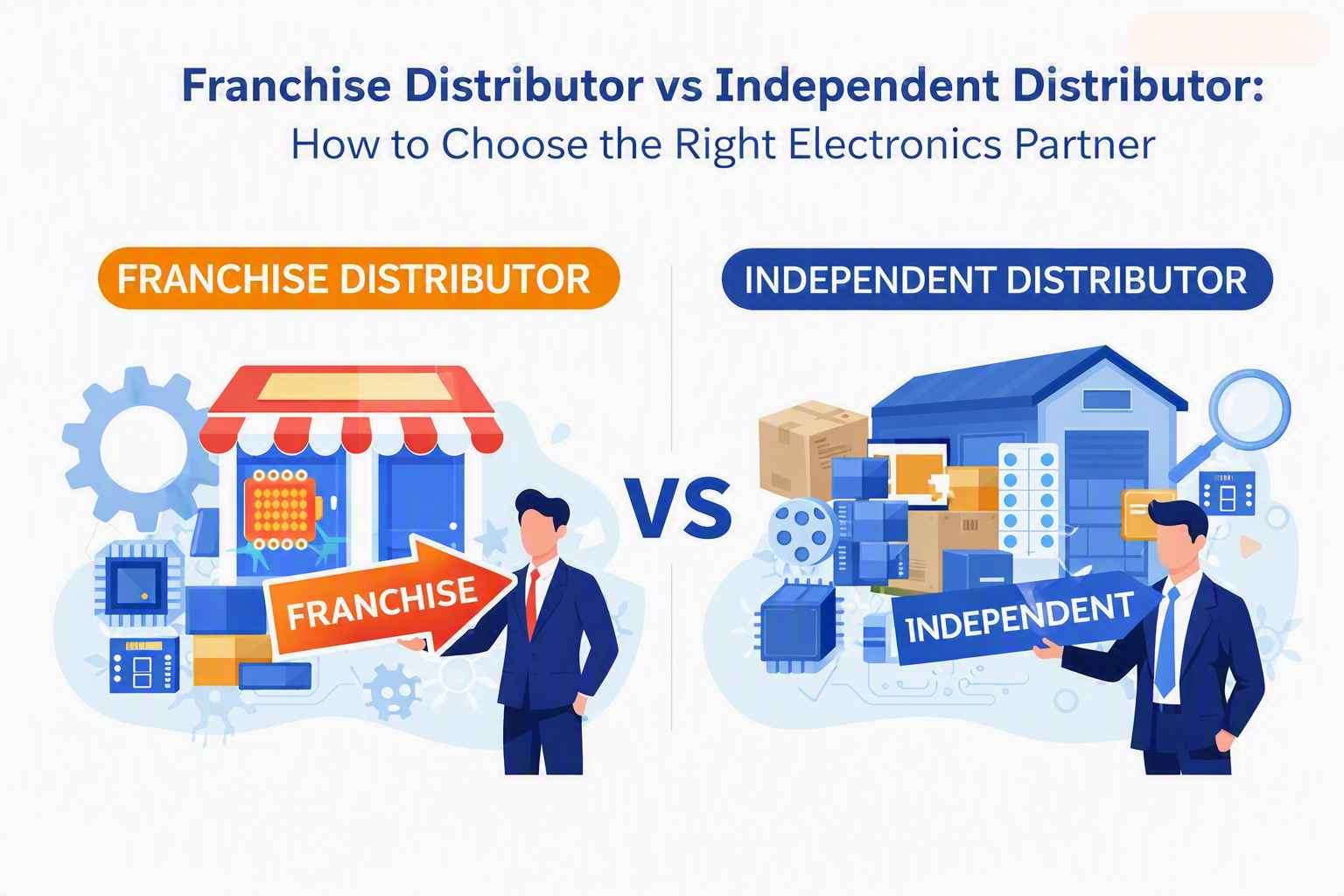
When you need active, fully compliant parts with guaranteed traceability, a franchise (authorized) distributor is the safer route, even though MOQs and lead times are fixed by the manufacturer. When you need hard-to-find, EOL, or mixed-BOM parts fast and without MOQ restrictions, an independent distributor fills the gap, though buyers take on more counterfeit and traceability risk. The right choice depends on which of those two risks your project can absorb.
| Factor | Franchise Distributor | Independent Distributor |
|---|---|---|
| Source | Direct manufacturer contract | Open market, multiple suppliers |
| Best for | Active, compliance-critical parts | EOL, hard-to-find, mixed BOM |
| MOQ | Set by manufacturer, often high | Flexible, often no minimum |
| Lead time | Standard to 30+ weeks | Typically faster, sub-12 weeks possible |
| Traceability | Full | Variable, needs inspection |
| Counterfeit risk | Low | Higher |
| Pricing | Fixed, little negotiation room | Volatile, demand-driven |
A franchise distributor, also called an authorized distributor, holds a formal contract with the original manufacturer to sell that manufacturer's genuine parts. This is the core distinction in franchise distributor vs independent distributor electronics sourcing, and it's the same distinction people mean when they ask about authorized distributor vs broker: authorization. Because the manufacturer backs the supply chain, buyers get consistent quality, documented origin, and a direct line to engineering support.
Franchise distributors work best when a project needs active parts, components under a recent PCN or PDN, or parts that must meet strict compliance standards. They can occasionally arrange special production runs for EOL parts, though that service comes with large MOQs and premium pricing. The tradeoff is flexibility: MOQs are set by the manufacturer, lead times can run 30 weeks or more during shortages, and if the manufacturer is short on supply, the distributor is short too.
Genuine Parts Backed by Manufacturer Contracts — Franchise distributors can only sell parts the manufacturer has authorized, which is why buyers who need guaranteed-genuine components default to authorized sourcing.
Manufacturer Technical Support and EOL Production Runs – Because the relationship runs through the manufacturer, franchise distributors can pull in engineering support and, in some cases, negotiate special production runs to keep a device in production past its official EOL date.
Advance Notice on PCN, PDN, and EOL – Franchise distributors get PCN and PDN notices directly from manufacturers, giving buyers time to build buffer stock before a part disappears from the market.
Full Traceability and Compliance – Every component can be traced back to its manufacturer lot, which matters for industries with strict quality and compliance standards.
Lower Counterfeit Risk – Since parts move through a single authorized channel, the risk of counterfeit or remarked components is close to zero.
Rigid, Uniform Pricing – Franchise distributors follow manufacturer pricing structures, so there's little room to negotiate on bulk orders.
MOQ and Lead Time Constraints – Low-MOQ or rush orders are hard to accommodate, since the same MOQs and lead times the manufacturer sets bind the distributor.
Exposure to Manufacturer Shortages – If the manufacturer faces an allocation shortage, driven for example by tariff-related supply chain disruption, the franchise distributor faces it too, with no independent buffer stock to fall back on.
An independent distributor, sometimes called a broker, sources components from the open market rather than through a manufacturer contract. Supply comes from surplus factory production, excess stock from other distributors, and, in some cases, recycled or reclaimed parts. That mix of sources is what makes an independent distributor useful when a franchise distributor and the manufacturer both come up empty.
Independent distributors are the practical choice for EOL and hard-to-find parts, sudden sourcing needs outside standard lead times, and mixed-BOM orders with no MOQ restriction. If a project needs parts in under 12 weeks, an independent distributor can often move faster than a franchise distributor can.
Global, Multi-Source Sourcing – Independent distributors aren't tied to one manufacturer, so that they can pull inventory from multiple regions and suppliers at once.
Access to Surplus and EOL Stock – Excess production, distributor overstock, and recycled components all flow through the open market, so independent distributors can often locate parts, like older STM32 microcontrollers, that no longer exist through official channels.
No MOQ, Faster Lead Times, Mixed-BOM Support – Because manufacturer contracts don't bind them, independent distributors can fill low-quantity and mixed-BOM orders faster than a franchise distributor typically can.
Traceability Gaps and Counterfeit Risk – Sourcing from multiple, sometimes unverified suppliers raises the risk of counterfeit or remarked parts, which is the central concern in any authorized distributor vs broker comparison.
Price Volatility – Open-market pricing shifts with demand and availability, and EOL parts in particular can carry a steep premium.
For active, compliance-critical parts, a franchise distributor is worth the fixed pricing and longer lead times. For EOL parts, mixed BOMs, or urgent sourcing, an independent distributor fills the gap a franchise distributor can't. Many procurement teams use both: a franchise distributor for the bulk of an active BOM, and an independent distributor for the handful of hard-to-find or EOL parts that hold up production. Before locking in either option, it's worth mapping which line items on your BOM actually drive cost versus which ones need dedicated EOL sourcing – see our guide to planning for component EOL before it stops production.
Need both sides covered? Get a quote from our sourcing team or browse our current stock and material inventory for active and EOL parts.
When Should You Choose an Authorized Distributor of Electronic Components?
Choose an authorized distributor for active parts that need full traceability and minimal counterfeit risk, and when your project has no urgent lead-time requirement.
When Should You Choose an Independent Distributor of Electronic Components?
Choose an independent distributor when a manufacturer or authorized distributor can't meet your needs, most often when sourcing EOL parts from the open market.
What Are the Risks of Sourcing From an Independent Distributor or Broker?
The main risks are counterfeit components and low traceability, since parts come from multiple open-market suppliers. Inspect parts carefully before accepting them.
What Are the Limitations of an Authorized Distributor of Electronic Parts?
Authorized distributors can't offer rush supply below standard lead times or MOQs lower than what the manufacturer allows, and they face the same shortages manufacturers do.
Who's the Better Choice for Hard-to-Find Parts: an Authorized Distributor or an Independent Broker?
An independent distributor is generally the better choice for hard-to-find and EOL parts.
Chip shortages rarely start with anything dramatic. A small uptick in retail demand for phones, c
READ FULLDefense procurement is not like commercial buying. The margin for error is zero, the paper trail
READ FULLIndustrial Automation Electronics: Which ICs Matter for PLCs and SC
READ FULL