Select your Language :

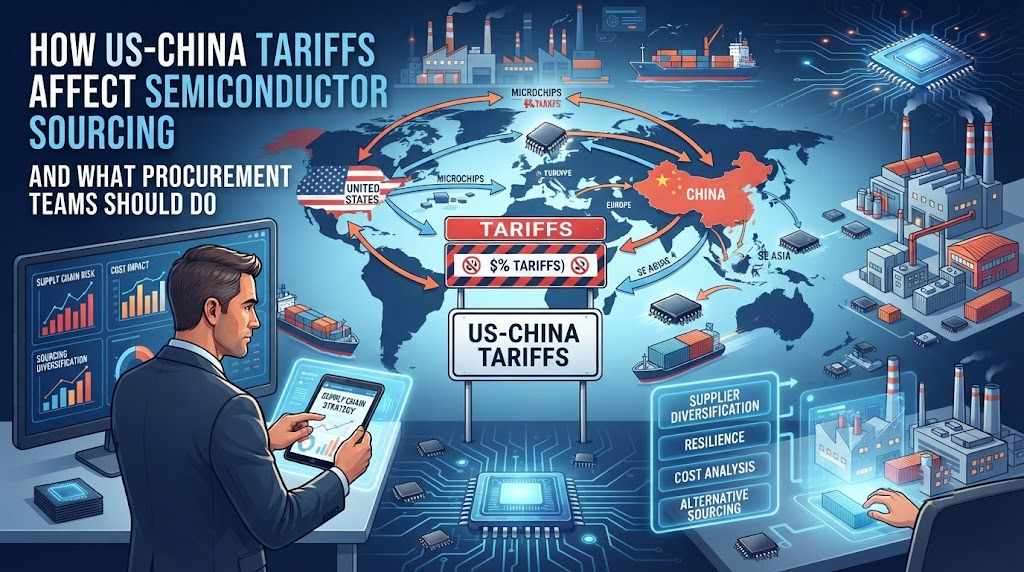
Tariff rates and deadlines below reflect USTR guidance as of July 2026.
Section 301 tariffs on Chinese-origin semiconductors have stood at 50% since January 2025, up from 25% previously. A separate Section 232 layer adds 25% on certain advanced computing chips and AI processors, effective since January 2026, and combined rates can reach 75% or more on stacked categories. A further escalation is scheduled for June 23, 2027, currently set at 0% with the exact rate to be announced at least 30 days in advance.
If you're still sourcing semiconductors from China using cost models from 2023, you're likely overpaying by 30 to 50%. That figure seems shocking, but it is true. This is the new impact of the US-China trade war, and it's here to stay.
The US-China trade tensions have created a complex, multi-layered tariff regime on semiconductor imports, with rates that can stack and compound when you least expect them. Keeping track of which tariff applies to which component, from which country, at which point in the production cycle, is exhausting, but it's also essential to your bottom line. If you're sourcing semiconductors from China under current tariff rules, you're likely paying significantly more than the headline rate suggests, and that gap is only going to widen.
Section 301 tariffs on Chinese-origin semiconductors have stood at 50% since January 2025, up from 25% previously. A further tariff layer is scheduled to take effect in 2027. Expect the landscape to keep shifting.
The price shock of tariffs for your semiconductor procurement strategy is serious. Absorbing these costs is not possible. Instead, you need to shift from reactive cost-tracking to a proactive supply chain structure that has a built-in tariff resilience from the ground up. Tactical responses are fine for emergencies, but adapting your entire supply chain to handle tariffs is the only sustainable path forward. A mindset shift is also required. Tariff volatility has become a permanent feature of the US-China trade relationship, and the sooner you accept that, the sooner you can take the necessary measures.
Before you can plan your response to tariffs, you need to understand what you're up against. Let's dive deep because this isn't a single tariff you're dealing with. It's a stack.
This goes back to the Trade Act of 1974, which is a response to Chinese intellectual property and technology transfer practices that the USTR has been tracking for years. Semiconductor rates have held at 50% since January 2025, a jump from 25% that reshaped sourcing math for anyone still buying from China.
The applicable HTS codes are found in Chapters 85 and 90, specifically subheadings 8541.x and 8542.x --covering diodes, transistors, integrated circuits, processors, and memories. You'll want your customs broker to double-check every single code on your import documents. A single misclassification can cost you thousands.
The thing you need to understand is that Section 301 applies only to China and Hong Kong-origin goods. Other countries face 0% Section 301 duty. That's where the loophole lies and also where your sourcing strategy needs to shift.
Just when you think you've got Section 301 figured out, there comes an additional tariff layer. Section 232 has imposed a 25% tariff on certain advanced computing semiconductors and AI processors since January 2026. According to this layer certain products are exempt(US data centers, R&D, startups, consumer electronics), but you'll need to qualify for them proactively. You can't assume you're exempt. You will need to submit proof.
Then there's IEEPA and reciprocal tariffs. These create a baseline upon which other duties are built. Think of them as the foundation, and Section 301 and 232 are the floors you add on top.
This is where it gets tricky. Multiple tariffs can apply simultaneously, pushing effective rates from 50% to 75% or more on certain semiconductor categories. You need to model this at the SKU level, not just the category level.
The USTR has determined that China's semiconductor dominance policies are actionable under Section 301 and the USTR has taken action by passing another restriction. Currently, the tariff is set at 0% but an increase is scheduled for June 23, 2027. The exact rate will be announced no fewer than 30 days prior.
The covered products include 18 semiconductor categories with specific HTS classifications. You'll want to map your entire bill of materials against this list well in advance.
That means you have an 18-month window for structural supply chain changes.
There's some good news buried in all this complexity. Existing exemptions for 178 product categories run through November 10, 2026 under the US-China trade agreement, worth calendaring now since that deadline is only months away. So you need to keep track of your imports to see if you're not overpaying unnecessarily on these exempt items.
Section 232 also offers specific relaxation for the following businesses: data centers, repair and replacement, R&D, startups, consumer electronics, civil industrial applications, and the public sector. Each has its own qualification criteria, so you'll need to work with your legal team to confirm if you are eligible.
Many procurement teams are exploring ways to circumvent these tariffs. One way is for Chinese components to be assembled into PCBAs in third countries, usually Thailand or Vietnam. That way Section 301 tariffs will not apply since the final assembly country of origin is not China. It's worth a conversation with your trade compliance advisor.
You might be tempted to look at your existing landed cost model and simply plug in the new tariff rates. But you will run into problems because your spreadsheet is probably missing several critical layers. Let's break this down properly so you're not caught off guard.
First, let's get a clear idea about what landed cost actually includes:
Pre-2025 assumptions are simply wrong. Many cost models understate total landed cost by 30 to 50% under current effective tariff rates. If you're still using 2023 figures, your sourcing budget is based on outdated numbers.
The Federal Reserve and NBER analyses show an 80 to 94% passthrough rate. That means Chinese suppliers are not absorbing tariff costs; they're passing them directly to the buyer (you). Any hope that your supplier would eat the difference is wishful thinking.
At the component level, the impact of tariffs becomes even more noticeable. A semiconductor component at 50% Section 301 duty is also subject to additional tariff layers. So the final rates become significantly higher than what's printed on the tariff schedule. Your costing needs to reflect this at the SKU level.
Let us analyze a real-world comparison so you can see the numbers in action.
Assume that the semiconductor component has a $50 BOM cost:
That's a 77% increase from BOM to landed cost for the China scenario. The Mexico option? Just 66%. The difference is over $5 per unit. If you are ordering 100,000 units, that's half a million dollars in savings.
At 25% Section 301 rates, the China cost advantage disappears for many electronics categories.
Even your revised landed cost model might be missing some hidden charges like,
Now that you understand the landscape and the true cost picture, let's talk about what you can actually do about it. This isn't about panicking. It's about planning.
Your first move should be to shift your sourcing footprint. Vietnam, Mexico (under USMCA), and ASEAN economies all offer 0% Section 301 tariffs. These countries are a viable alternative because they're proven manufacturing hubs with already established supply chains.
Another measure to take is to diversify your supplier base. Avoid over-reliance on any single geography. Dual or triple sourcing for critical components gives you leverage and flexibility when tariffs shift.
But this is not enough. You must go the extra mile. That means designing your products for origin flexibility. Engineer them to accommodate region-specific components or final assembly configurations that qualify for lower duties. This may be harder to implement, but it pays off every time a tariff announcement drops.
Your standard purchase order terms probably don't account for tariff volatility. Time to change that.
Don't wait for annual sourcing events to re-evaluate your options. Markets move fast, and you need to move with them.
Timing is everything in tariff management.
There are legitimate tools available to reduce your tariff exposure. You just need to know they exist.
This is where relationships really pay off. Your suppliers are in this with you and they want to keep your business. That works in your favor.
Now let's get practical about semiconductor import tariffs, not just the big-picture strategy, but how they affect your day-to-day procurement work and what you can do about it right now.
When a tariff hike hits, your first instinct might be to freeze everything and wait for clarity. Resist that urge. Instead, take these immediate actions within 48 hours.
What if the tariff hike hits while you're in the middle of a production run? Here's how to keep the line moving.
Your legal team needs to be part of this conversation. A few specific clauses to review:
In this comprehensive guide we have navigated the tariff classifications, recalculated your landed costs, and built a solid strategy for what to do when the next hike hits. Now it's time to take action. Don't let this guide sit in your inbox and gather dust. Here's what you can do tomorrow:
You don't have to solve everything today. But you do need to start the conversation with your team, your suppliers, and your leadership. The tariffs aren't going away. And neither is the opportunity to build a more resilient, more cost-effective supply chain.
Chip shortages rarely start with anything dramatic. A small uptick in retail demand for phones, c
READ FULLDefense procurement is not like commercial buying. The margin for error is zero, the paper trail
READ FULLIndustrial Automation Electronics: Which ICs Matter for PLCs and SC
READ FULL